
DSA Bubble Sort
DSA Bubble Sort – Beginner Friendly Guide
Bubble Sort is one of the simplest sorting algorithms in Data Structures & Algorithms (DSA).
It is mainly used for learning purposes and to understand how sorting works step by step.
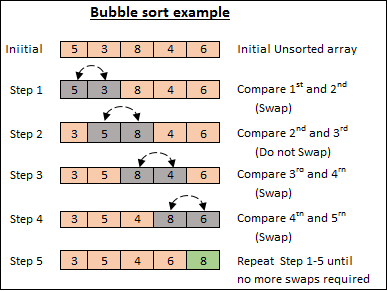
1️⃣ Bubble Sort – Manual Run Through (Step-by-Step) ⭐⭐⭐
🔹 Given Array
Bubble Sort compares adjacent elements and swaps them if they are in the wrong order.
🔸 Pass 1
Compare till the end (largest bubbles up)
✅ After Pass 1 → 8 is in correct position
🔸 Pass 2
Ignore last element (already sorted)
✅ After Pass 2 → 5 is in correct position
🔸 Pass 3
No swaps → array already sorted
🛑 Algorithm stops (optimized version)
✅ Final Sorted Array
2️⃣ Bubble Sort Algorithm (Logic) ⭐⭐
Basic Idea
Repeat comparisons
Swap adjacent elements if needed
After each pass, largest element goes to the end
3️⃣ Bubble Sort Implementation (C++) ⭐⭐
🔹 Basic Bubble Sort
Output
4️⃣ Optimized Bubble Sort Implementation ⭐⭐⭐
Stops early if no swaps occur in a pass.
📌 Important for exams & interviews
5️⃣ Bubble Sort Time Complexity ⭐⭐⭐
🔹 Comparisons Count
⏱ Time Complexity Table
| Case | Condition | Time Complexity |
|---|---|---|
| Best Case | Already sorted (optimized) | O(n) |
| Average Case | Random order | O(n²) |
| Worst Case | Reverse sorted | O(n²) |
🧠 Why Worst Case is O(n²)?
Two nested loops
Each element compared multiple times
6️⃣ Space Complexity ⭐⭐
| Metric | Value |
|---|---|
| Extra Space | O(1) |
| Type | In-place sorting |
📌 Bubble Sort does not use extra memory
7️⃣ Important Properties (Exam Gold ⭐⭐⭐)
✔ Stable sorting algorithm
✔ In-place algorithm
✔ Comparison-based
✔ Not suitable for large datasets
8️⃣ Common Interview Questions ❓
Q1. Why is Bubble Sort called Bubble Sort?
👉 Largest element bubbles to the end
Q2. Is Bubble Sort stable?
👉 Yes
Q3. Can Bubble Sort be optimized?
👉 Yes, using swap flag
Q4. Why Bubble Sort is not used in practice?
👉 O(n²) time complexity
✅ Final Summary
✔ Bubble Sort swaps adjacent elements
✔ Largest element moves to end each pass
✔ Easy to understand & implement
✔ Optimized version stops early
✔ Time Complexity: O(n²)
✔ Space Complexity: O(1)
✔ Best for learning, not for production
