Introduction to MATLAB

Introduction to MATLAB
What is MATLAB?
MATLAB stands for Matrix Laboratory. It is a high-level programming language and interactive environment mainly used for numerical computation, data analysis, algorithm development, visualization, and simulation.
MATLAB is developed by MathWorks and is widely used in engineering, science, economics, medical technology, and research.
Why MATLAB is Special?
MATLAB is designed to work mainly with matrices and arrays, which makes complex mathematical problems easier and faster to solve.
Key strengths:
Easy-to-learn syntax
Powerful mathematical functions
Excellent graph & visualization tools
Large number of built-in toolboxes
Used in academics and industries
Where is MATLAB Used?
MATLAB is commonly used in:
Engineering (Mechanical, Electrical, Civil, Computer)
Signal & Image Processing
Data Analysis & Machine Learning
Control Systems
Medical Technology & Research
Finance & Economics
Features of MATLAB
Matrix-based language
High-level programming
Built-in mathematical functions
2D & 3D plotting
Simulink for modeling & simulation
Supports files like Excel, CSV, text
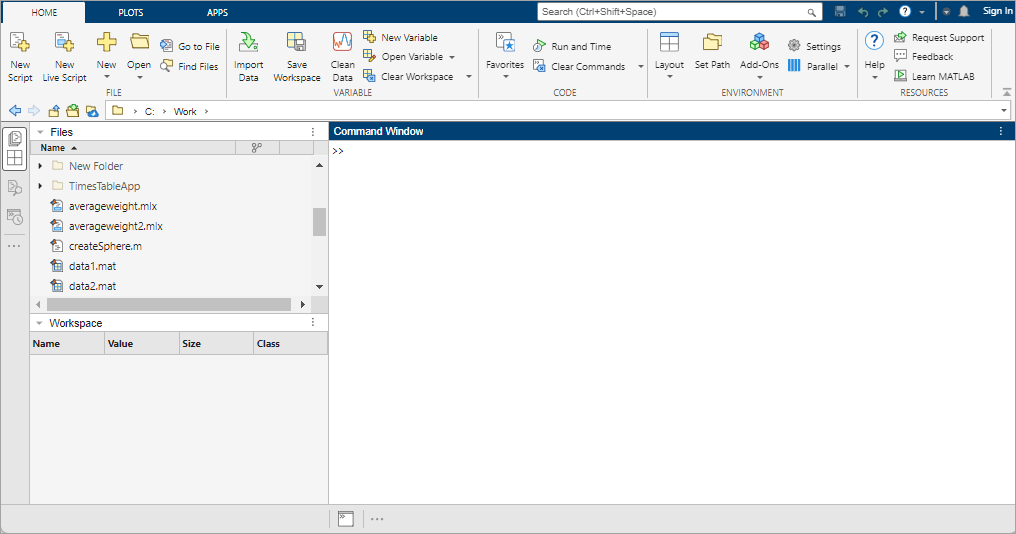
MATLAB Environment (Main Parts)
Command Window – Execute commands directly
Editor – Write and save MATLAB programs (.m files)
Workspace – Shows active variables
Command History – Previously used commands
First MATLAB Example
This shows how easily MATLAB handles calculations.
Advantages of MATLAB
Fast development time
Less code compared to C/C++
Excellent for mathematical modeling
Widely accepted in universities
Limitations of MATLAB
Paid software (license required)
Slower than low-level languages for some tasks
Who Should Learn MATLAB?
Students (Engineering, Science, Medical Tech)
Researchers
Data Analysts
Beginners in technical programming